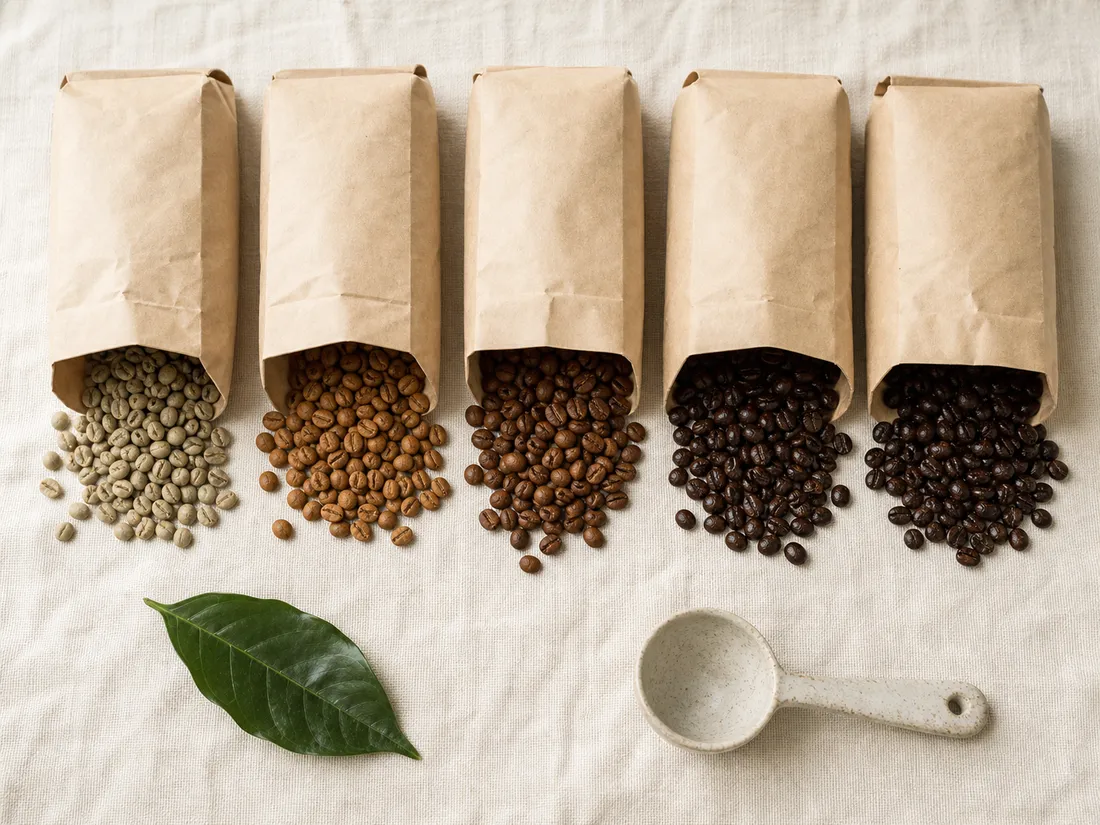
If you have ever browsed a roaster’s site and seen beans labelled “espresso roast”, “filter roast” and “omni roast” sitting next to each other — sometimes with the exact same origin on all three bags — you have probably wondered what the actual difference is. The honest answer is: it is mostly about roast level, and those labels are a shortcut to tell you which brew method the roaster calibrated for.
The beans are not categorically different. There is no such thing as an “espresso bean” at the species or variety level. What differs is how far the roast has been taken, and that choice affects how the coffee extracts under different levels of pressure, grind, temperature and brew time. This guide explains what each style actually means, when you can use one bag for both methods, and how to choose for your setup.
What espresso roast actually means
When a roaster labels a bag “espresso roast”, they mean they have taken the beans to a medium or medium-dark roast level — somewhere between the first crack and the second crack in roasting terms. At this development level, a few things happen: the original acids in the bean mellow, the body becomes heavier and more syrupy, and the sweetness from the roasting process itself becomes more pronounced.
All of this plays well under espresso extraction, which is a 25–35 second shot at 9 bars of pressure with a fine grind. That combination is aggressive — it extracts quickly and intensely — and a bean with lower acidity, more body and roast-derived sweetness holds up to it without tipping into sourness or astringency. The result is the thick, sweet, slightly bitter espresso most people expect.
An espresso roast also tends to be more forgiving if your technique is slightly off. The margin for error is wider than with a lighter roast, which is one reason most cafés and most home espresso setups use medium to medium-dark beans.
What filter roast actually means
A filter roast is typically lighter — stopped earlier in the roasting process, often close to or just past the first crack. At this development, the bean retains more of its intrinsic character: the acids are brighter, the aromatics are more volatile and complex, and the origin-specific flavour compounds that make an Ethiopian different from a Colombian are most clearly expressed.
This shows beautifully in low-pressure, long-contact brew methods like V60, Chemex, AeroPress and drip. These methods extract slowly and gently, and the clarity of a lighter roast gives them something interesting to show. A well-sourced Ethiopian on a V60 brewed at the right temperature can genuinely smell of jasmine and taste of stone fruit — not because anything was added, but because those aromatics survived a lighter roast intact.
The trade-off is that filter roasts are less forgiving. A slightly-off grind, too-hot water or the wrong ratio will express the acidity of a light roast as sharpness rather than brightness. Learning to brew light roast well takes a bit more attention than medium.
What omni roast means
Omni — short for omnidirectional — is a medium roast intentionally developed to work reasonably well across both espresso and filter. The roaster is splitting the difference: more development than a dedicated filter roast, less than a dedicated espresso roast. The acidity is present but controlled. The body is medium. It works in an espresso machine without being harsh, and it works on a V60 without being flat.
The honest trade-off: you get flexibility at the cost of peak performance in either direction. A purpose-built espresso roast will make better espresso than an omni. A purpose-built filter roast will make a more expressive V60 than an omni. But if you only want to buy one bag and use it on both your espresso machine in the morning and your pour-over on the weekend, omni is the practical answer.
| Roast style | Typical roast level | Best for | Characteristics |
|---|---|---|---|
| Espresso roast | Medium to medium-dark | Espresso, moka pot, milk drinks | Low acidity, heavy body, roast-forward sweetness, forgiving |
| Omni roast | Medium | Both espresso and filter | Balanced, flexible, sacrifices peak performance in either direction |
| Filter roast | Light to medium-light | V60, Chemex, AeroPress, drip | Bright acidity, complex aromatics, origin-forward, less forgiving |
Can you use filter beans for espresso?
Yes — and this is worth knowing because it unlocks a lot of interesting territory. Brewing a filter roast as espresso is sometimes called “light espresso”, and the result is a very bright, acidic, concentrated shot that tastes nothing like a standard espresso. For some people this is fantastic. For others it is too sharp. It depends entirely on what you enjoy and whether your setup can handle it.
The main challenge is that light roasts are harder to dial in for espresso. Finer grind, lower temperature (86–90°C rather than 93–94°C) and a longer pre-infusion time generally help. You need a grinder with decent grind consistency, and you need patience — light espresso has a narrower extraction window than medium. If your shot tastes sour, it is under-extracted: try a finer grind or a slightly longer shot time.
The reverse — using an espresso roast for filter — generally works but produces a cup that tastes less complex and more straightforwardly dark. Not wrong, just less interesting than using a purpose-built filter roast.
How roast style interacts with grind and recipe
The roast level is not an independent dial — it interacts with every other variable in your recipe. Lighter roasts extract faster at a given grind size than darker roasts, because the cellular structure of the bean is less developed and the soluble compounds are more accessible. This means if you switch from a medium espresso roast to a light omni roast on the same espresso machine, your shot will likely run faster and taste more sour. You will need to grind finer to slow it down and extract fully.
On the filter side, lighter roasts usually call for slightly lower water temperature (88–92°C) compared to medium roasts (92–95°C). The aim is to extract the delicate aromatics without overcooking them. If you are new to light roast filter and the cup keeps tasting flat or harsh, temperature is often the variable to adjust first.
Quick decision guide
- Espresso machine only: Buy a dedicated espresso roast. Lower acidity, more body, easier to dial in.
- Filter only (V60, AeroPress, drip): Buy a filter roast. Brighter, more expressive, shows off origin best.
- Both espresso and filter, one bag: Buy an omni roast. It is the honest middle ground.
- Curious about light espresso: Buy a filter roast and experiment. Grind finer, drop your temperature to 88–90°C, be patient.
- French press or moka pot: Treat these like espresso — medium to medium-dark is safest.
☕ Find your match
Filter The Beans Hub by roast style — browse espresso, filter and omni roast beans from Malaysian roasters, or filter by roast level to narrow it down further.
Frequently Asked Questions
What is the difference between espresso beans and filter beans?
There is no such thing as a bean that is inherently “espresso” or “filter” — the difference is in how the roaster has calibrated the roast level for a specific brew method. Espresso roasts are typically medium to medium-dark, which means lower acidity, more body and more sweetness that hold up under pressure extraction. Filter roasts are typically lighter, which means more acidity, more delicate aromatic compounds and more origin character that show through in low-pressure brewing.
Can you use filter beans for espresso?
Yes. Brewing a light roast filter bean as espresso is sometimes called “filter espresso” or “light espresso”, and it produces a very bright, acidic, intense shot. It is harder to dial in than a purpose-built espresso roast and can taste sour if your grind or recipe is off. But done well, it is a genuinely interesting style. You need a decent grinder and patience.
What is an omni roast?
An omni roast — short for omnidirectional — is a medium roast calibrated to work reasonably well for both espresso and filter. It sits in the middle ground between a dedicated espresso roast and a dedicated filter roast. You sacrifice some of the best qualities of each style in exchange for flexibility. If you only want one bag for one machine, omni is a practical choice.