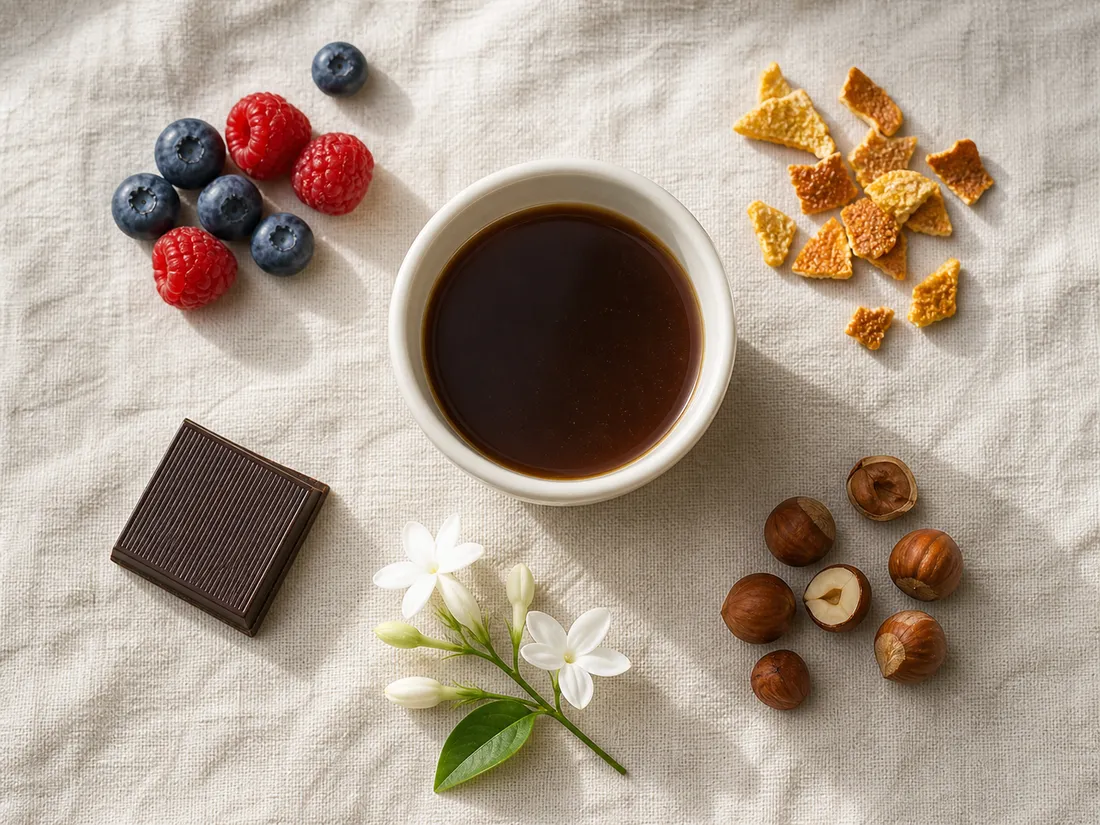
"Blueberry jam with a floral finish"
…Errrr, but all I taste is coffee?
That's me even after drinking coffee daily for 3-4 years.
So… What Are Flavour Notes in Coffee?
When you see things like "blueberry jam", "floral", "caramel" — it can feel a bit… dramatic.
Like, really meh?
I've even seen crazy notes like lemongrass and honey. How can a coffee taste like lemongrass even? So, to help me understand these better, I decided to learn from the best. I went to work in a coffee roastery, where the founder goes to coffee competitions as sensory judge, best way to learn it I guess.
So apparently, these taste notes are shortcuts people use to describe what they taste. Coffee naturally has compounds that can remind us of fruits, flowers, nuts, chocolate. It comes from where the coffee is grown, what type of plant it is, how it's processed, and how it's roasted.
So yes, some coffees really do have a berry-like or floral kind of taste.
💡 The tricky part
There's no crash course, or one button that can make you instantly identify these taste notes. How good you are in identifying, is depending on how intentional you are when you're eating, and how much you can remember. It's like showing a red colour to a 2-month-old baby. The baby can see it, but cannot say "this is red". Because no one has taught the brain yet. Coffee is the same.
Why Does Everything Just Taste Like… Coffee?
When you drink something, your brain tries to match it with what it already knows.
If it cannot find a match?
It just says: "ok… this is coffee."
That's it.
The more flavours you've experienced before — and the more you've named them — the easier it becomes to recognise them again.
Same reason a chef can taste 5 spices in one dish, and we just say "wah nice".
How Do You Taste Flavour Notes in Coffee? (Without Overthinking)
You don't need to be expert. Just try these:
5 things to try right now
- Smell first. Before drinking — smell it. Does it feel fruity? Nutty? Chocolatey? Don't need to be accurate. Just guess.
- Let it cool a bit. Hot coffee = everything tastes the same. When it cools down a bit, flavours start to show.
- Slurp (yes, really). Sounds weird, but it works. It spreads the coffee across your whole mouth and helps you taste more.
- Think big first, then small. Don't jump to "blueberry". Start with: fruity or not? Sweet or not? Bright or not? Then slowly zoom in.
- Compare 2 coffees. This is the fastest way. A washed and natural pair from the natural vs washed coffee guide is perfect for this. Side by side, you'll suddenly realise: "oh… this one actually different".
A Simple Way to Find Flavour Notes in Coffee
If you taste something like…
| If you taste… | It might be… |
|---|---|
| Bright and sharp | Citrus / green apple |
| Sweet and jammy | Berries / dried fruit |
| Smooth and rich | Chocolate / caramel |
| Earthy | Nuts / wood |
| Light and soft | Floral |
No need to be perfect. Just close enough is enough.
Does It Get Easier?
Yes. And more fun.
At first, everything still tastes like coffee. That's normal.
But slowly… you'll start noticing small things:
- a bit of sweetness at the end
- a light fruity feeling
- something "different" you can't fully explain yet
Then one day you read: "blueberry jam with a floral finish"
…and you'll go: "eh… I think I can taste that"
That moment? Worth it.
☕ Start simple
You don't need expensive gear. You don't need to be expert. Just try different coffees — and pay a bit more attention each time. When you're ready to use flavour notes to actually buy beans, our how to choose coffee beans guide shows you how to use them to filter and pick, and our flavour atlas maps which taste notes come from which origin across 850 Malaysian-roasted beans. Browse our current bean selection, each one comes with tasting notes to guide you.