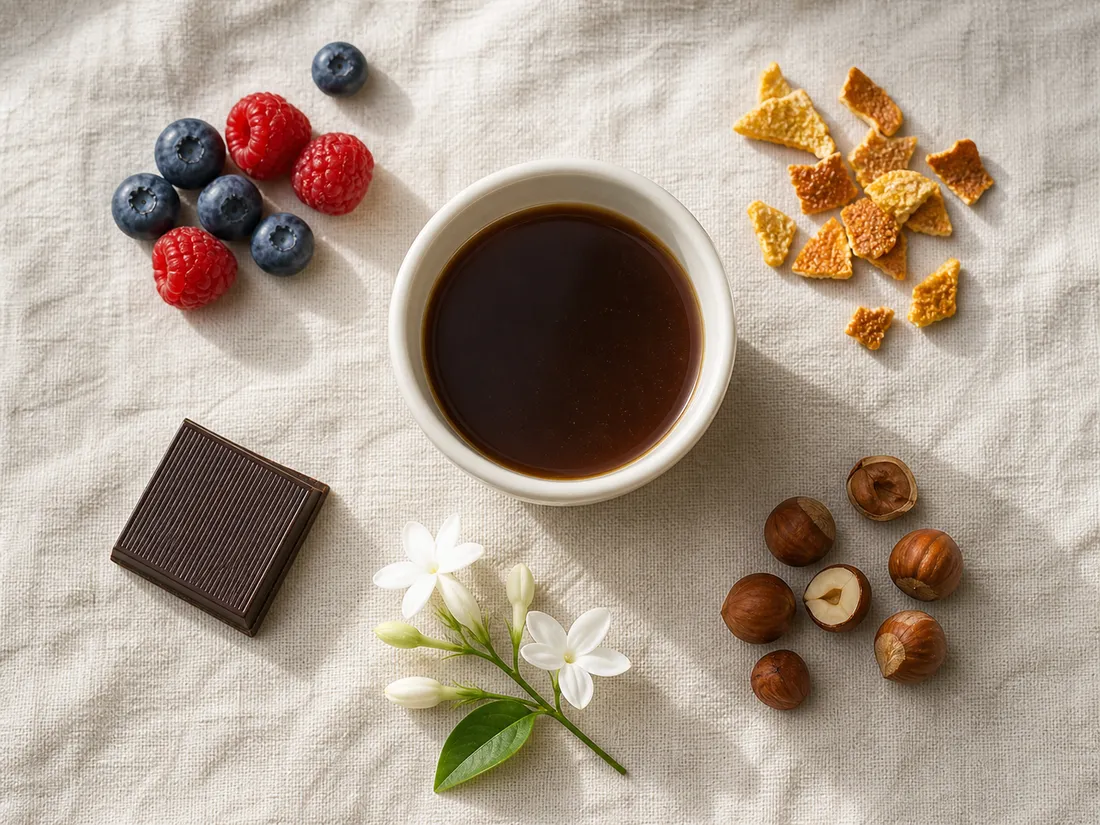
Somewhere in Malaysia right now, a roaster is selling a coffee that tastes like lemongrass. Another one tastes like Milo. There's a bean with biscoff on the label, one with brown sugar milk tea, and one that tastes like a cigar. These aren't gimmicks — they're real coffee taste notes on real bags from Malaysian roasters, and they're hiding in plain sight among the 850 beans we mapped for this atlas. If you've ever picked up a bag, read "bergamot, coffee blossom, roselle" and quietly put it back down — this page is the translation layer.
The atlas covers the taste notes of 850 beans across 59 Malaysian roasters in The Beans Hub catalogue, mapped mid-2026. One honest caveat: notes are what the roaster tastes and promises, not a lab result — treat them as a well-informed preview, not a guarantee.
The flavour map: 8 families, one search box
Every taste note on the Malaysian market sorts into eight flavour families — the same eight you can filter by in our catalogue. Type a flavour you love into the box (try strawberry, caramel or jasmine), or tap a family to open it.
 FruityOn 648 of 850 beans — the biggest family by far▾
 SweetOn 334 beans▾
 Nutty / CocoaOn 290 beans — the everyday family▾
 FloralOn 259 beans — the priciest family▾
 RoastedOn 41 beans▾
 Green / VegetativeOn 46 beans▾
 SpicesOn 34 beans▾
 Sour / FermentedOn 33 beans — small but wild▾
Bean counts use each bean's flavour categories, so one bean can appear in more than one family. Chocolate alone appears on 96 bags — the single most common taste note in Malaysia.
If you like this, buy that: the origin cheat sheet
Here's the finding that makes this atlas useful rather than just pretty: origins have statistical signatures. We compared how often each note appears on beans from one origin versus the whole market — and some flavours point at one origin like a compass.
| If you like… | Buy… | How strong the signal is |
|---|---|---|
| Blackcurrant, Ribena | Kenya | 8.8x more likely than average — the strongest signature in the data |
| Strawberry, berry jam | Ethiopian naturals | A third of all strawberry beans; two-thirds are natural process |
| Chocolate, nuts, caramel | Brazil | Nutty 4.6x, milk chocolate 4.4x, caramel 3x |
| Jasmine, raspberry, orange blossom | Panama | Raspberry 6.5x, orange blossom 6.1x, jasmine 4.9x |
| Bergamot, blueberry | Ethiopia | Bergamot 3.5x, blueberry 3x |
| Plum, cherry | Honduras | Plum 4.5x, cherry 4.3x |
| Red apple | Colombia | 3.8x |
| Honey | Costa Rica | 3x |
| Jackfruit, dried longan, black tea | Malaysian Liberica 🇲🇾 | The signature of our own beans — see below |
Two ways to use this. Shopping forwards: love Ribena? Start with a Kenyan. Shopping backwards: loved a bean with plum notes? There's a good chance it was Honduran — now you know what to look for next time. If reading notes on a bag still feels like decoding poetry, our guide to reading flavour notes covers why roasters write them this way.
Flavour has a price tag
Here's something we didn't expect to find: the flavour on the bag predicts the price on the tag. Beans whose notes say nutty sell at a typical RM37 per 200g. Chocolate and caramel: RM40. Then the florals: jasmine RM106, rose RM120, raspberry RM126, white grape RM160.
Chocolate is the cheapest flavour in Malaysia. Florals cost three times more. It isn't arbitrary — floral notes come from high-grown, carefully processed, usually lightly roasted lots (Geishas above all), while chocolate and nut notes come from dependable workhorse origins like Brazil. Your palate sets your budget: if you're a chocolate-and-caramel person, specialty coffee is cheap for you. If you fall in love with jasmine, we're sorry about your wallet — our full Malaysian coffee bean price guide breaks down what to pay at every level.
The one-of-a-kind shelf: beans that taste like nothing else
Out of 816 distinct taste notes in the catalogue, most appear on just one or two beans. Some of them are so specifically Malaysian, or so gloriously odd, that they deserve their own tour. Every bean below is real and buyable right now.
The one that tastes like durian
Yes, really. Add milk and the roaster promises durian-like richness. The only bean in the catalogue brave enough to put the king of fruits on the label.
The one that tastes like Milo
An experimental-process Indonesian with Milo and madu kelulut (stingless-bee honey) on the label. Childhood in a cup, upgraded.
The one that tastes like brown sugar milk tea
For everyone who queued for boba in 2019: a Brazilian single-origin espresso that gets you there for RM40, no queue.
The one that tastes like biscoff
Cheapest bean on this list and possibly the most crowd-pleasing: a Brazil that tastes like the biscuit everyone steals from the café counter.
The one that tastes like a cigar (on purpose)
A village lot from Indonesia that finishes with an unapologetic cigar note. Polarising, memorable, and exactly why single lots are fun.
The one that tastes like Malaysia
Grown in Tampin, Negeri Sembilan. Jackfruit, dried longan and sarsaparilla — a flavour profile no imported bean can copy, because it's ours.
The Malaysian signature: jackfruit, longan and black tea
One pattern in the data belongs to us alone. Malaysian-grown coffee is mostly Liberica — a different species from the Arabica everywhere else in this atlas — and across beans from different farms and different roasters, the same three notes keep appearing: jackfruit, dried longan and black tea. Five separate Malaysian Liberica beans in the catalogue carry a longan note. That's not coincidence; that's terroir.
No Ethiopian tastes like longan. No Brazilian tastes like jackfruit. If you want to taste something that exists nowhere else in the coffee world, the answer grows in Johor and Negeri Sembilan — our Liberica guide tells the full story of Malaysia's own coffee.
💡 One thing before you trust any label
Taste notes assume decent brewing and fresh beans. Brew the bag black at least once, within a month of the roast date, before deciding the roaster imagined things. Milk is wonderful — but it mutes strawberry and erases jasmine.
Frequently Asked Questions
What are the most common coffee taste notes in Malaysia?
Chocolate and floral are the most common individual taste notes on Malaysian-roasted specialty coffee — each appears on roughly 75 of the 850 beans we mapped, with honey, caramel and citrus close behind. Fruity is the most common overall category, appearing on more than three-quarters of all beans.
Which coffee origin tastes like strawberry?
Ethiopia, most reliably — a third of the strawberry-note beans on the Malaysian market are Ethiopian, and two-thirds of them are natural or anaerobic process. The natural process (drying the coffee cherry around the bean) is what produces the strawberry and berry-jam character, so look for "Ethiopia" plus "natural" on the bag.
Why doesn't my coffee taste like the notes on the bag?
Taste notes describe resemblances, not ingredients — a bean with "strawberry" on the bag contains no strawberry, it shares acidity and sweetness patterns with one. Notes also assume good brewing: too coarse or too fine a grind mutes them, and milk covers delicate notes entirely. Brew it black with a recent roast date and the resemblance usually appears.
What do Malaysian-grown coffee beans taste like?
Malaysian-grown coffee is mostly Liberica, a different species from the Arabica most specialty roasters use, and it has a signature profile all its own: jackfruit, dried longan and black tea appear again and again across beans from different farms and roasters. It tastes like nothing else in the catalogue — bold, tropical and distinctly local.
🗺️ Put the atlas to work
Filter all 854 beans by these exact flavour families in the coffee bean catalogue — or answer three quick questions and let us match beans to your taste.