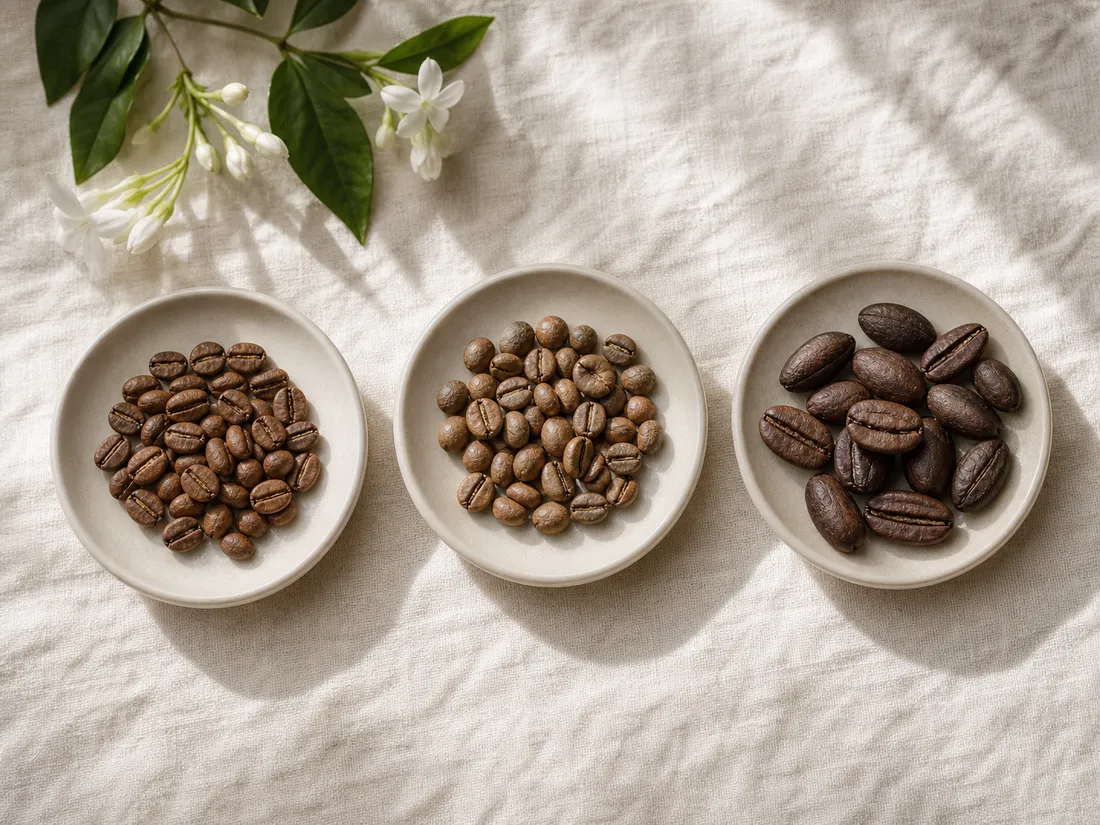
What Liberica coffee actually is
Coffea liberica is one of the four commercially relevant coffee species, alongside Arabica, Robusta, and Excelsa — though botanists now classify Excelsa as a subspecies of Liberica (Coffea liberica var. dewevrei). The species originates from Liberia and the broader West African tropical belt, where wild specimens were first documented by European botanists in the mid-19th century. Unlike Arabica, which requires highland growing conditions above 1,000 metres, Liberica thrives in hot, humid, lowland environments — which is precisely why it found such a lasting home in Malaysia.
The bean itself is unmistakable once you've seen it. Liberica cherries are noticeably larger than Arabica or Robusta cherries, and the dried bean is asymmetric — one side is flatter, the other more curved, with a slight hook at the tip. In a side-by-side comparison with an Ethiopian Arabica bean, Liberica looks almost outsized. This isn't just an aesthetic detail; that larger seed, slower maturation, and different chemical composition all contribute to Liberica's distinct cup profile, which has no real parallel in any other species.
The broader species comparison — including how Liberica sits relative to Arabica and Robusta in terms of flavour, price, and usage — is covered in the complete coffee species guide. For a direct two-species comparison, the Liberica vs Arabica guide goes deeper on that specific question.
Why Malaysia became the home of Liberica
The story of Liberica in Malaysia starts with a catastrophe. Coffee leaf rust — caused by the fungal pathogen Hemileia vastatrix — swept through global coffee plantations beginning in the 1860s, devastating Arabica crops across Asia. Sri Lanka's coffee industry, once one of the most productive in the world, was essentially wiped out by the mid-1880s (the island pivoted to tea, which is why it became famous for it). The rust spread through India, Indonesia, and the Malay Peninsula in waves, destroying Arabica crops that colonial planters had established in lower-altitude plantations unsuitable for the species in the first place.
Colonial authorities needed a disease-resistant replacement. Liberica, which had largely escaped the rust due to different growing conditions and plant biology, was trialled as a substitute crop. It was introduced into what was then British Malaya in the 1890s, and it took root in Johor's flat, humid lowland conditions with striking success. While other regions eventually abandoned Liberica in favour of Robusta (which turned out to be even easier to grow at scale), Johor's planters kept cultivating it, and that tradition persisted through independence and into the present day.
Today, Malaysia grows approximately 90% of the world's commercial Liberica supply. That's not a small figure — it means Malaysia essentially holds a monopoly on a coffee species that has been consumed daily by millions of Malaysians for over 130 years, mostly without those consumers knowing what species they were drinking. The Malaysian coffee heritage guide traces the full cultural history of how that cup ended up in front of you at a kopitiam.
What Liberica tastes like
Describing Liberica to someone who's only had Arabica specialty coffee is genuinely difficult, because the reference points don't transfer cleanly. Start with bold — Liberica is a heavy, full-bodied cup. The aroma is intense before you even brew, with a pronounced woody and smoky character that's noticeable the moment you open the bag.
In the cup, expect:
- Woody and smoky — the most consistent flavour descriptors across different Liberica lots. Not in an unpleasant way, but decidedly earthy and roast-forward.
- Floral notes — some well-processed Liberica lots show jasmine or hibiscus aromatics, particularly in lighter roasts. This floral quality is one of the traits that specialty roasters find most interesting.
- Fruit character — often described as jackfruit-like, which is apt: there's a tropical, almost fermented sweetness in certain lots that doesn't resemble any fruit note you'd encounter in Ethiopian Arabica.
- Heavy body and long finish — Liberica lingers. The aftertaste can persist for several minutes, carrying those woody and smoky notes.
Traditional kopi-style Liberica — drum-roasted with sugar and sometimes butter — compresses and transforms this profile considerably. The sugar caramelises during roasting, the smokiness intensifies, and the result is what most Malaysians know as the taste of morning kopi: dark, slightly sweet, deeply roasted, with a heaviness that cuts through condensed milk without disappearing.
Specialty Liberica, processed more carefully and roasted lighter, shows an entirely different face. The florals come forward, the body is still heavy but more structured, and the fruit character is cleaner and easier to identify. If you've been dismissing Liberica based only on kopitiam experience, specialty-processed versions are genuinely surprising.
Liberica in traditional Malaysian kopi
Walk into a traditional kopitiam in Johor Bahru, and there's a good chance the kopi you're being served is made from Liberica — either pure or blended with Robusta. The Hainanese and Hokkien immigrants who built Malaysia's kopitiam culture starting in the late 19th century developed a roasting style specific to local conditions: drum-roasting the beans with rock sugar and sometimes butter or margarine at high heat, producing a caramelised dark roast that is categorically different from any Western roasting style.
That process transforms the bean. The sugar coating creates a slightly sweet, deeply caramelised exterior. The high heat drives off moisture and concentrates the roast-forward flavours — smoke, dark bitter chocolate, a characteristic heaviness — while suppressing the more delicate aromatics that a specialty roaster would work to preserve. Then it's brewed through a cloth sock filter (a "kopi sock") in a very concentrated form, served with either condensed milk (kopi), evaporated milk (kopi C), or black with sugar (kopi O).
This isn't a simplified version of specialty coffee — it's a completely different tradition with its own standards, techniques, and cultural weight. The Malaysian coffee heritage guide covers the kopitiam tradition in full, including white coffee from Ipoh and the regional differences across peninsular Malaysia.
Understanding Liberica's role in kopi culture also means understanding the contrast with Arabica, which arrived in Malaysia primarily through the specialty wave of the 2010s rather than through kopitiam tradition.
Specialty Liberica — the new wave
For most of its history in Malaysia, Liberica was a commodity. Grown, roasted in the traditional style, and sold to kopitiams without any focus on traceability, processing quality, or cup profile. That's changing, slowly but noticeably. A small number of Malaysian farmers and roasters have started treating Liberica with the same care that the specialty industry applies to Arabica — selective picking, controlled fermentation, careful drying on raised beds, lighter roasts that preserve aromatics.
The results are striking. Specialty Liberica lots from Johor, cupped properly and brewed well, show complexity that commodity Liberica simply doesn't. The floral notes — particularly jasmine and a light hibiscus quality — become prominent. The fruit character that's hard to identify in a dark kopi-style roast becomes clearer and more distinctive. The body is still full, still distinctly Liberica, but the smokiness retreats enough to let other flavours show up.
International interest is growing too. Liberica has appeared at specialty coffee competitions and trade events as an unusual and distinctly Malaysian product. For a country that grows 90% of the world's supply, having specialty Liberica become a recognised single-origin product would be a significant development — comparable to what single-origin Jamaican Blue Mountain did for Jamaican coffee identity decades earlier.
If you're interested in trying specialty Liberica, keep an eye on offerings from roasters focusing on the Malaysian specialty coffee scene, which has been growing quickly and increasingly features local origins alongside imported Arabica.
Should you try Liberica
If you're Malaysian and you've spent any time in a kopitiam, you've almost certainly already had Liberica without knowing it. The question is whether you should try it in its specialty-processed form, or as a deliberate exploration rather than a morning routine habit.
The honest answer is yes, and here's why: Liberica is one of the most genuinely Malaysian food experiences available, in the same way that durian is — intense, polarising to newcomers, but deeply embedded in the country's agricultural and cultural identity. Trying it with some knowledge of what you're tasting, rather than just ordering kopi because that's what's there, changes the experience entirely.
How to try it
If you can find a specialty-roasted Liberica, brew it as a pourover or French press — methods that let the full body show without too much manipulation. Use a slightly coarser grind than you would for Arabica. Taste it black first, then with milk if you prefer. Compare the aroma before and after brewing — Liberica's aromatics shift dramatically in the cup.
If specialty Liberica isn't accessible to you, try ordering a kopi at a traditional kopitiam and drinking it slowly, thinking about what you're tasting rather than just consuming it. The woody smokiness, that distinctive heaviness, the way condensed milk integrates differently with Liberica than it would with an Arabica — these are specific sensory markers tied to a specific Malaysian agricultural history. For a full comparison of how Liberica stacks up against its more famous competition, the Liberica vs Arabica guide is worth the read.
Frequently Asked Questions
What does Liberica coffee taste like?
Liberica has a bold, distinctive flavour profile quite unlike Arabica or Robusta. Common descriptors include woody, smoky, full-bodied, and floral — with a fruit character that's sometimes compared to jackfruit. The cup is heavy and lingering, with less brightness than Arabica but a far more complex aroma than most Robusta. Traditional kopi-style Liberica roasted with sugar adds a caramelised, bittersweet dimension that rounds it out further.
Where is Liberica coffee grown in Malaysia?
The primary Liberica-growing region in Malaysia is Johor, particularly in districts like Kluang and surrounding lowland areas. The species thrives in Malaysia's flat, humid, hot terrain — conditions that are actually unsuitable for Arabica. Some Liberica is also grown in parts of Pahang and other states, but Johor accounts for the majority of production. Malaysia as a whole grows roughly 90% of the world's commercially available Liberica supply.
Is Liberica coffee the same as kopi?
Not exactly — kopi is the general Malay/Hokkien word for coffee, and traditional kopi can be made from Liberica, Robusta, or a blend of both. However, Liberica is a cornerstone of traditional Malaysian kopi, particularly in the south. The beans are roasted in the traditional kopi style — drum-roasted with sugar and sometimes butter — which transforms the flavour significantly. What you get in a kopitiam cup is kopi-style Liberica, not specialty-processed Liberica.
Can I buy Liberica coffee beans online in Malaysia?
Specialty Liberica beans — properly processed and sold as single-origin lots — are becoming more available from Malaysian roasters who are starting to take the species seriously. Traditional kopi-style Liberica grounds have long been available at provision shops and wet markets. For specialty Liberica, check with KL and Johor-based specialty roasters, or browse The Beans Hub's current offerings at the shop.