How coffee arrived in Malaysia
Malaysia's coffee story starts in the 19th century and runs through colonial agriculture, plant disease, immigration, and cultural reinvention. It does not start with specialty roasters or third-wave cafés. Understanding what kopi actually is — and why it tastes so different from the Arabica specialty coffee now sold across KL — means starting with that longer history.
The British introduced coffee cultivation to the Malay Peninsula in the 1870s, initially planting Arabica at lowland estates. The timing was poor. Coffee leaf rust — the fungal disease Hemileia vastatrix — was already devastating Arabica crops across Asia, and the lowland Malayan conditions were unsuitable for Arabica anyway. When the rust swept through, most Arabica plantations failed.
Liberica was introduced in the 1890s as a disease-resistant alternative, and it found a natural home in Johor's hot, humid, flat lowlands — terrain that Arabica could never tolerate. Smallholder farmers, and later Chinese immigrant communities building the kopitiam trade, adopted Liberica as their primary raw material. By the time Malaysia achieved independence in 1957, a distinct local coffee culture had already been in place for generations. That culture is kopi.
For a deeper look at how Liberica became Malaysia's native coffee species, the Liberica Malaysia guide covers its agricultural and botanical story in full.
Kopitiam culture and the kopi tradition
A kopitiam is a traditional Chinese-style coffee shop, and the word itself combines the Malay kopi (coffee) with the Hokkien tiam (shop). The kopitiam format — marble-topped tables, wooden chairs, ceiling fans, a long counter with a cloth-sock coffee filter, kaya toast, half-boiled eggs — was established by Hainanese and Hokkien immigrants in the late 19th and early 20th centuries across the Malay Peninsula, Singapore, and Indonesia.
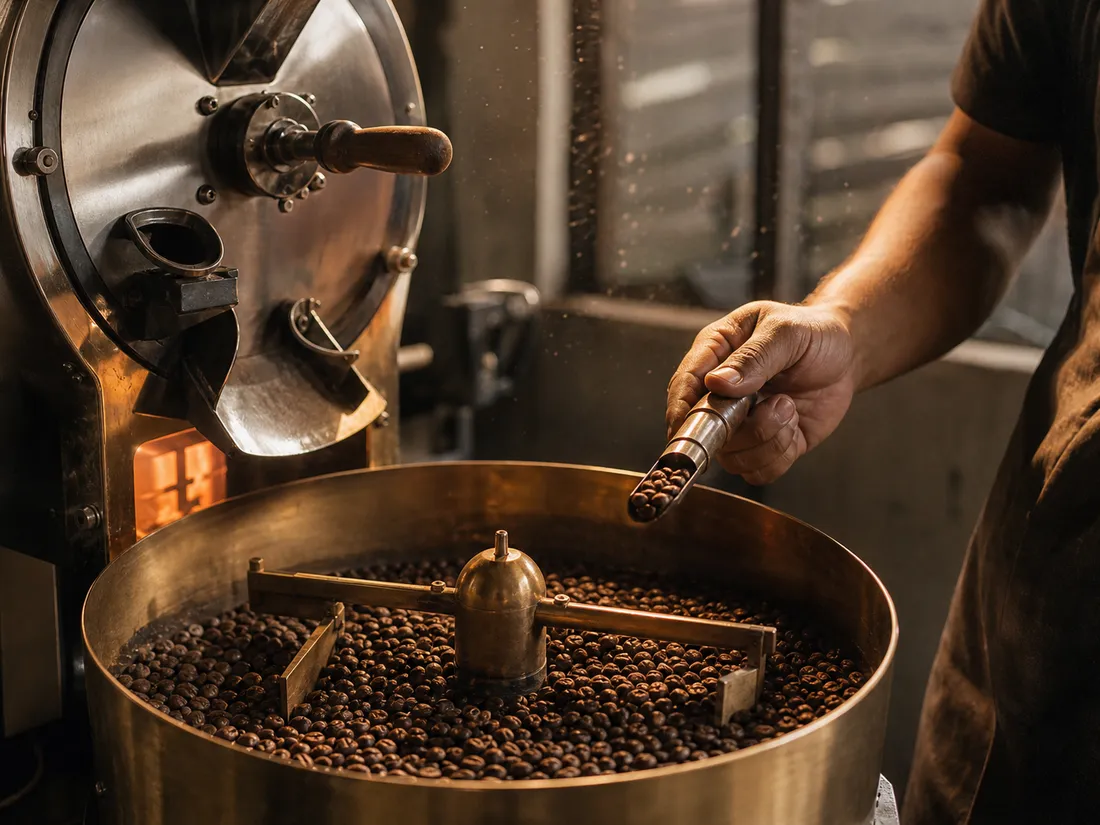
The roasting style they developed is specific to this tradition. Coffee beans — almost always Liberica or Robusta, or both blended — are drum-roasted at high heat with rock sugar and sometimes butter or palm margarine. The sugar caramelises around the beans during roasting, producing a dark, slightly sweet exterior. The final bean is intensely roasted, far darker than any specialty roast level, and the flavour profile is built around that caramelisation: smoky, bittersweet, dense, heavy.
Brewing happens through a kopi sock — a cloth filter shaped like a windsock — using a metal stand. Hot water is poured through the finely ground kopi, and the concentrate drips into a waiting jug. Cups are assembled to order: condensed milk poured first, then the coffee concentrate on top, sometimes stirred, sometimes not. The result is thick, sweet, and unmistakably Malaysian.
This is not a simplified version of European coffee culture. It is a completely independent tradition with its own technique, aesthetics, and social role. The kopitiam was — and still is — where daily life happens: morning papers, business conversations, school runs, retirement routines. Kopi is not a leisure drink in the specialty-coffee sense. It is infrastructure.
The kopi order guide
If you walk into a traditional kopitiam for the first time, the menu can feel like a code. Here is what the key orders actually mean:
- Kopi — coffee with condensed milk. The standard order. Sweet, creamy, strong.
- Kopi O — black coffee with sugar, no milk. O comes from the Hokkien word for black.
- Kopi C — coffee with evaporated milk and sugar. C refers to Carnation brand evaporated milk, which became the standard. Less sweet than kopi, slightly thinner in body.
- Kopi O Kosong — black coffee, no sugar. Rare to order, occasionally available.
- Kopi Tarik — pulled coffee. The concentrate is poured back and forth between two jugs from height, aerating it into a frothy, slightly cooler cup. More common in Malay-run mamak stalls than Chinese kopitiams.
- Kopi Panas / Sejuk — hot or cold. Adding ais (Malay for ice) gets you kopi ais.
- Kopi Gah Dai — extra condensed milk, for those who want it very sweet.
Regional variations exist. Penang kopi tends to be stronger and more bitter. Johor kopi often uses Liberica, producing a distinctive woodiness and body. KL kopitiams serve a wider spectrum depending on whether the shop leans Hainanese, Cantonese, or has updated its menu for a younger clientele.
Ipoh white coffee
Ipoh white coffee — kopi putih — is one of the more misunderstood items in Malaysian coffee culture, partly because of how heavily it has been branded and packaged for export. The original Ipoh white coffee is not white in colour. It is called white coffee because the roasting method omits sugar.
Traditional Ipoh white coffee is roasted with only palm oil margarine — no sugar, no caramelisation. The lower roasting temperature and the absence of sugar produces a bean that is lighter in colour than standard kopitiam kopi, with a mellower, less bitter flavour and a softer body. It is still served with condensed milk as standard, which provides the sweetness that the roasting process does not. The overall cup is gentler than kopitiam kopi, with a slightly creamy, malt-like character.
The style developed among Ipoh's substantial Hainanese community, centred on Old Town — the historic commercial district where a handful of kopitiams established the format in the early 20th century. Shops like Nam Heong and Oldtown (the original, not the chain) have been serving the same recipe for generations.
The packaged Oldtown White Coffee brand, launched in 1999, took the name and general concept to a national then international scale. The instant and café versions are a commercial interpretation rather than a faithful reproduction of the original — they are useful to know about as a distinct product, but drinking one is not the same experience as a cup at a Hainanese kopitiam in Ipoh.
Worth noting
Ipoh white coffee has nothing to do with flat whites, white coffee in the UK sense (which just means coffee with milk), or any espresso-based drink. If someone in Malaysia offers you kopi putih, expect a milky, mellow, malt-flavoured cup — not a latte.
Liberica — Malaysia's own coffee species
Liberica sits at the foundation of Malaysian kopi culture in a way that most drinkers have never stopped to think about. Malaysia grows roughly 90% of the world's commercial Liberica supply, almost all of it from Johor. The species found permanent roots here after the coffee leaf rust crisis of the 1880s and 1890s, and it never left.
In traditional kopi, Liberica contributes its signature body and smokiness. The high-heat sugar roasting compresses and transforms the flavour — the woodiness and floral character that appears in specialty-processed Liberica gets driven out, leaving something darker and more caramelised. What survives is the weight and the lingering finish, which is why a cup of kopi made with Liberica has a particular persistence that Robusta-only kopi doesn't quite replicate.
A growing number of Malaysian roasters are now processing Liberica in the specialty style — selective picking, washed or natural processing, lighter roasting — to surface the origin's actual flavour potential. The results are genuinely different from kopitiam kopi, and from Arabica specialty coffee. The full Liberica guide covers what specialty-processed Liberica tastes like and where to find it.
For the broader comparison of all three major coffee species, the complete coffee species guide explains where Liberica, Arabica, and Robusta sit relative to each other in terms of flavour, price, and usage.
Specialty coffee and kopi today
Malaysian coffee culture now runs on two parallel tracks that rarely intersect directly. The kopitiam tradition continues — there are still thousands of traditional shops operating across peninsular Malaysia, and a whole category of "new kopitiam" cafés has emerged, updating the aesthetic while keeping the kopi menu. At the same time, a substantial specialty coffee scene has developed in KL, Penang, JB, and smaller cities, built on imported Arabica beans, modern espresso equipment, and a café culture that looks more like Melbourne or Seoul than the old Chinatown kopitiams.
The interesting space is where these two traditions start to notice each other. A handful of specialty roasters — particularly in KL and Johor — are now sourcing Malaysian-grown Liberica alongside imported Arabica, presenting both on their menus and letting customers compare them side by side. That comparison is genuinely educational. It shows that Malaysian coffee is not just a lesser, older version of what arrived later — it is a distinct tradition with its own species, its own processing methods, and its own cultural weight.
If you want to find the specialty roasters currently active in Malaysia, the specialty coffee Malaysia guide and the Malaysian roasters guide both cover the current scene in detail.
The two worlds do not need to compete. Kopi O in the morning and a V60 Yirgacheffe in the afternoon is not a contradiction — it's a reasonable day in a country with two equally valid coffee traditions. Understanding both of them makes you a more informed drinker, regardless of which cup you prefer.
Frequently Asked Questions
What is kopi Malaysia?
Kopi is the Malay and Hokkien word for coffee, and in Malaysia it refers to the traditional coffee drink served at a kopitiam. It's made from darkly roasted Liberica or Robusta beans (roasted with sugar), brewed through a cloth sock filter, and served with condensed milk as standard. Kopi O is black with sugar; kopi C uses evaporated milk; kopi tarik is pulled for froth. It is a distinct tradition from Western espresso-based coffee and from third-wave specialty coffee.
What is Malaysian white coffee?
Malaysian white coffee (kopi putih) originated in Ipoh and refers to beans roasted with only palm oil margarine — without sugar or high-heat caramelisation. The result is lighter, less bitter, and mellower than standard kopitiam kopi. It's served with condensed milk. Ipoh white coffee has nothing to do with flat whites or lattes — it's a traditional Malaysian roasting style, not an espresso drink.
What coffee bean is used in traditional Malaysian kopi?
Traditional Malaysian kopi uses Liberica or Robusta beans, or a blend of both. Liberica is the native-grown species, primarily cultivated in Johor, where Malaysia produces roughly 90% of the world's commercial Liberica supply. Arabica was not part of the kopitiam tradition — it arrived in Malaysian café culture through the specialty movement of the 2010s.
How is kopitiam coffee different from specialty coffee?
Kopitiam kopi uses Liberica or Robusta beans roasted in the traditional style with sugar — producing a dark, smoky, intensely flavoured cup brewed through a cloth sock and served with condensed or evaporated milk. Specialty coffee uses Arabica beans roasted at controlled temperatures to highlight origin flavours, brewed via espresso, pour-over, or AeroPress. Both are valid traditions — they have different goals, different histories, and different flavour results.