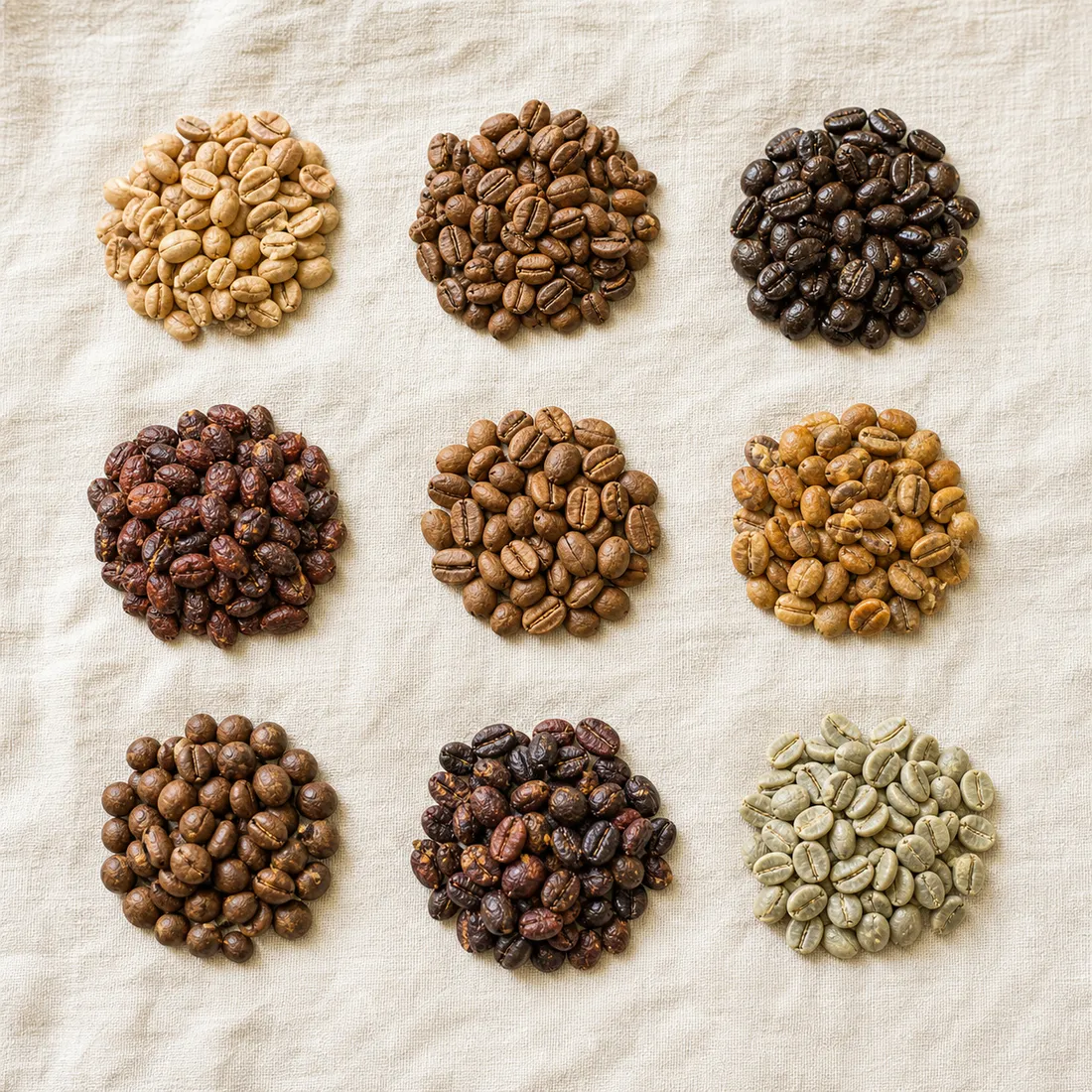
Why the species matters more than the roast
Most coffee conversations in Malaysia start and end with roast level — "dark", "medium", "light" — as if that's the whole story. But roast level is something a roaster applies to a bean that already has a fixed genetic ceiling. The species and variety of the plant determine the flavour compounds available in the first place. A beautifully handled light roast of a low-quality Robusta will still taste flat and harsh. A mediocre roast of an exceptional Ethiopian Arabica will still show fruit. The raw material comes first.
There are four commercially relevant coffee species: Arabica, Robusta, Liberica, and Excelsa (which is now classified as a subspecies of Liberica). In practice, you'll encounter three of them regularly in Malaysia — and Malaysia is one of the few countries in the world where all three show up in your daily cup depending on which shop you walk into. Your morning kopi at the kopitiam, your V60 at a KL specialty cafe, and a trendy Johor Liberica pour-over are all drawing from different species entirely.
Understanding how processing methods affect flavour is also important, but none of that matters until you understand what's inside the seed itself. This guide covers all three species thoroughly — where they come from, how they taste, and which one a Malaysian home brewer should reach for first.
Arabica — the specialty standard
Coffea arabica is the species that launched the global specialty coffee movement, and for good reason. It accounts for roughly 60% of the world's coffee production and virtually 100% of what you'll find in specialty cafes. The plant originates from the highlands of Ethiopia, where wild coffee trees still grow in forests at elevations between 1,500 and 2,000 metres above sea level. Those high-altitude growing conditions — cool nights, consistent rainfall, mineral-rich volcanic soil — produce beans with a wide, complex flavour range that no other species quite matches.
What you taste in Arabica depends enormously on origin and processing. Ethiopian Arabica often brings jasmine, bergamot, blueberry, or lemon. Colombian lots tend toward red apple, caramel, and milk chocolate. Guatemalan beans can run dark fruit and brown sugar. The common thread is brightness — Arabica carries natural malic and citric acids that give the cup lift and structure, the same way a good wine has acidity that makes it feel alive rather than flat.
If you want to go deeper on this species, the full Arabica guide covers flavour range, why it costs more, and how to pick your first specialty bag. For a direct head-to-head with Robusta, the Arabica vs Robusta comparison lays it out side by side. You can browse Arabica blends available in Malaysia at the shop if you already know what you're after.
The catch with Arabica is fragility. The plant is susceptible to coffee leaf rust (a fungal disease that devastated global crops in the 1860s and again in the 2010s), it requires specific altitude and climate conditions, and it yields less fruit per tree than Robusta. All of that translates to higher prices — typically RM 40–120 for a 250g bag of specialty Arabica, versus RM 15–30 for commodity Robusta blends.
The quick species comparison guide is a useful companion read if you want a faster overview alongside this one.
Robusta — stronger, cheaper, and often misunderstood
Coffea canephora — sold under the name Robusta — gets dismissed in specialty circles as the cheap, harsh option. That reputation isn't entirely unfounded, but it's incomplete. The problem is that most Robusta in circulation is commodity-grade, processed carelessly and roasted dark to mask defects. Judged fairly, specialty-grade Robusta from Vietnam, Uganda, or parts of India is a genuinely interesting cup — dark chocolate, tobacco, earth, sometimes a walnut or grain note, always heavy-bodied and dense.
The plant itself is remarkable. It grows from sea level up to about 800 metres, tolerates heat and humidity that would kill an Arabica tree, resists the leaf rust fungus that periodically devastates Arabica crops, and produces about twice the yield per hectare. Its caffeine content sits at roughly 2.7% by dry weight, compared to Arabica's 1.5%, and that caffeine functions as a natural insect repellent — one reason the plant is so disease-resistant. If you want to understand caffeine differences in more detail, understanding what drives flavour in the cup is a good place to start.
In Malaysia, Robusta is the backbone of traditional kopi. The beans are drum-roasted with sugar (and sometimes butter) at high heat, producing a caramelised, bittersweet roast style unlike anything you'd find in a Western specialty roastery. That intense roast and the condensed milk or sugar in traditional preparation mask Robusta's earthier notes while amplifying its body and caffeine punch — which is exactly what kopitiam regulars want at 7am. The full Robusta guide covers this culture in detail, including what makes good Robusta worth seeking out.
Italian espresso blenders have known for decades that Robusta adds crema — the thick, reddish-brown foam on a well-pulled shot — and body that pure Arabica espresso sometimes lacks. Many classic Italian house blends run 10–30% Robusta. That's not a compromise; it's a deliberate flavour choice.
Liberica — Malaysia's own species
Of all the coffee trivia that Malaysians tend not to know about their own country, this one stands out: Malaysia grows approximately 90% of the world's commercial Liberica supply. The species (Coffea liberica) is named for Liberia in West Africa, where it originates, but it found its commercial home in Malaysian soil — particularly in Johor — after a catastrophic series of events in the 1890s.
Coffee leaf rust (Hemileia vastatrix) swept through global Arabica plantations during the second half of the 19th century, effectively wiping out the entire coffee industry in Sri Lanka and devastating crops across Asia. Colonial planters needed a disease-resistant replacement. Liberica, which had largely escaped the rust, was introduced into Malaya as that replacement crop, and it took root in Johor's lowland conditions in a way that Arabica never could.
The bean itself looks nothing like Arabica or Robusta — it's noticeably larger, asymmetric, almost lopsided, with a distinctive hooked shape. The flavour is equally distinct: woody, smoky, bold, sometimes floral, occasionally reminiscent of jackfruit, which gives it an unmistakably tropical character. The aroma tends to be pronounced even before brewing. It's unlike any cup you've had from an Ethiopian or Colombian bean, and that's the point — for a deep dive, the full Liberica guide covers growing regions, processing, and where to buy it. The Liberica vs Arabica comparison is also worth reading if you're deciding which species to try next.
Liberica is the soul of Malaysian kopi culture — it's what many traditional kopitiams use, often blended with Robusta, roasted with sugar in the classic Malaysian style. Understanding Liberica also means understanding where Malaysian coffee came from, which the Malaysian coffee heritage guide covers from kopitiam origins to the modern specialty scene.
Excelsa — which is sometimes listed as a separate species on bags in Malaysia — was reclassified by botanists in 2006 as Coffea liberica var. dewevrei, making it technically a Liberica variety. It has a slightly different flavour profile, tending toward tart fruit and a lighter body, and it's grown in some of the same Johor regions.
Which species should a home brewer start with
If you're building a home brewing setup and want to understand what good coffee can taste like, start with Arabica. Specifically, start with a washed Ethiopian or Colombian single-origin — something in the RM 50–80 range for 250g — and brew it as a pour-over or Aeropress. Washed processing (where the fruit is removed before drying) gives you the clearest window into the bean's inherent flavour, and those two origins produce the widest, most accessible flavour range in Arabica. You can explore the origins guide to understand why different growing regions produce such different results.
Once you've got a baseline for what Arabica tastes like — that brightness, those fruit and floral notes, that clean finish — you'll have a reference point for everything else. Try a natural-processed Arabica (fruit left on during drying) and you'll notice it's heavier, more fermented, more wine-like. Try a Robusta-forward blend and the difference in body, earthiness, and caffeine hit is immediately obvious.
Liberica is worth experiencing specifically as a Malaysian cultural thing. If you've only ever had specialty Arabica, a traditional kopitiam Liberica kopi will genuinely surprise you — the smokiness, the weight, the way it holds up to condensed milk. Going in with an open mind rather than a specialty coffee palate is the right approach.
The Arabica vs Robusta guide goes into more detail on how to decide between the two for your home setup, including which brewing methods suit each species better.
How species affects what you pay
Species is one of the biggest drivers of coffee pricing in Malaysia, but it interacts with processing, origin, and roaster positioning in ways that make simple comparisons difficult. Here's the rough landscape as of 2026:
- Commodity Robusta blends (used in most grocery-store ground coffee and instant sachets): RM 8–20 for 200g. This is the category that dominates volume sales in Malaysia.
- Specialty Arabica single-origins: RM 40–120 for 250g depending on origin and processing rarity. Ethiopian and Colombian lots are common. Gesha varieties or anaerobic fermented lots from Panama or Taiwan can exceed RM 150 for 100g.
- Liberica: Commodity Liberica for traditional kopi is cheap — often below RM 15 for 200g of pre-roasted grounds. But specialty Liberica lots, properly processed and sold as single-origin bags, are increasingly scarce and can command RM 60–100 for 250g.
The price gap between Arabica and Robusta reflects real cost differences: Arabica requires high-altitude farms, hand-picking of selectively ripe cherries, careful processing, and lower yields. Specialty processing — particularly honey or natural — adds labour costs. When you're paying RM 80 for a 250g bag of Ethiopian natural Arabica, a meaningful portion of that is going to farmers operating at 1,800 metres with small-plot cultivation and careful post-harvest handling.
Where each species grows in the world
Coffee grows in the equatorial band between roughly 25°N and 30°S — a region called the Coffee Belt. Within that band, each species has distinct growing conditions that shape its distribution.
Arabica dominates Brazil (the world's largest producer, particularly in Minas Gerais and São Paulo states), Ethiopia, Colombia, Guatemala, Honduras, Yemen, and parts of East Africa including Kenya and Tanzania. It needs altitude — typically 1,000–2,000 metres — to develop its full flavour complexity. The cooler temperatures at altitude slow cherry development, giving the bean more time to accumulate sugars and flavour compounds.
Robusta is concentrated in West and Central Africa (Ivory Coast, Uganda, the Democratic Republic of Congo), Vietnam (which produces enormous volumes for the instant coffee industry), and parts of India and Indonesia. Vietnam alone accounts for roughly 40% of global Robusta supply, much of it going into instant coffee and espresso blends. Growing at lower altitudes and in hotter, wetter conditions, Robusta plants mature faster and produce more fruit per tree.
Liberica is almost exclusively a Malaysian story at commercial scale. Small amounts are grown in the Philippines (where it's called Barako) and parts of West Africa, but Johor's lowland plantations produce the vast majority of commercially available Liberica globally. The species thrives in Malaysia's flat, humid terrain — the same conditions that made Arabica cultivation impractical and Liberica's disease resistance so valuable when it was first introduced.
Understanding origin alongside species gives you the full picture of why a bean tastes the way it does — which is why the coffee bean origins guide pairs naturally with this one. And once you know which species interests you, browsing the shop by origin is the fastest way to find something to try at home.
Frequently Asked Questions
What is the difference between Arabica and Robusta coffee?
Arabica (Coffea arabica) grows at higher altitudes — typically 1,000–2,000 metres — and produces a sweeter, more complex cup with fruit and floral notes. Robusta (Coffea canephora) grows lower, contains roughly twice the caffeine at around 2.7% versus Arabica's 1.5%, and tastes bolder and earthier. Robusta is also hardier and cheaper to produce, which is why it dominates commercial blends and instant coffee.
What makes Liberica coffee unique to Malaysia?
Malaysia grows roughly 90% of the world's commercial Liberica supply, primarily in Johor. The species arrived in the 1890s as a replacement for Arabica crops wiped out by coffee leaf rust. Liberica has a distinctively large, asymmetric bean and a flavour profile unlike either Arabica or Robusta — woody, smoky, and sometimes compared to jackfruit. It underpins traditional Malaysian kopi culture and is experiencing a specialty revival.
Which type of coffee bean has the most caffeine?
Robusta has the highest caffeine content among the three major species, at around 2.7% caffeine by dry weight. Arabica sits at approximately 1.5%, and Liberica falls somewhere between the two. This is one reason Robusta is favoured in espresso blends — it contributes body, crema, and a caffeine kick without requiring as much coffee by weight.
What types of coffee beans does The Beans Hub carry?
The Beans Hub carries a curated selection of specialty coffee beans sourced from top growing regions, including Ethiopian single origins, Colombian lots, Brazilian naturals, Yunnan (China), Indonesian, and Thai beans. You can browse Arabica blends, natural-process coffees, washed lots, and fermented experimental lots at the shop.